Children’s Rights Week in English
Some of the educational material for the Children’s Rights Week has also been translated into English!
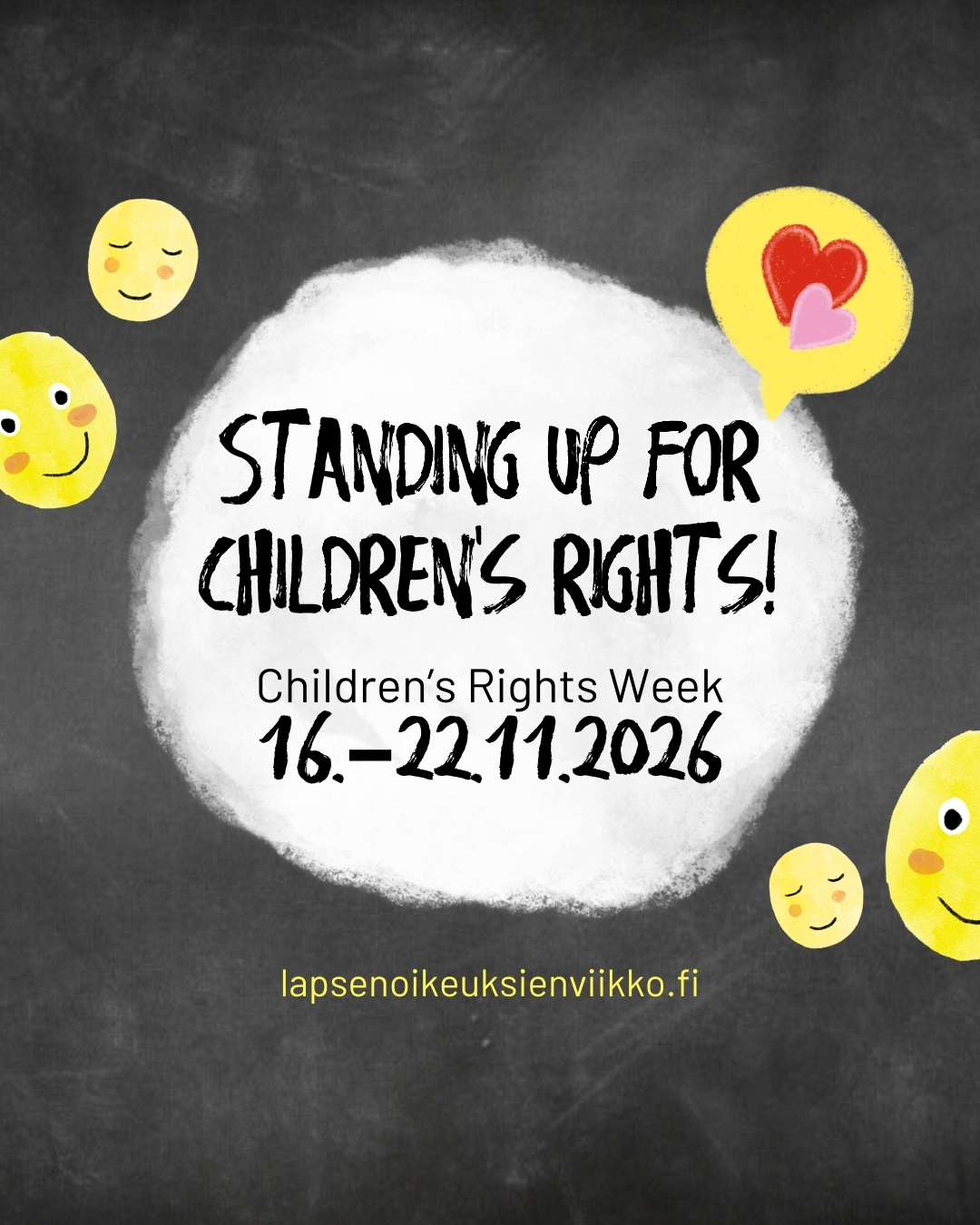
Explore the Convention on the Rights of the Child and the theme for 2026: Every child has the right to be valued. #I’mValued, #You’reValued.
The next theme week is celebrated from 16 to 22 November 2026. The materials for 2026 are published.
Materials for Children’s Rights Week in English
The theme for Children’s Rights Week in 2026 is every child’s right to be valued. Every child and young person is valuable just as they are, and everyone deserves to be treated with respect. The materials explore the topic from many different perspectives.
The materials can be adapted for children of different ages in grades 1-9.
Psst
You can also have a look at Finnish National Agency for Education’s learning materal (oph.fi) about children’s rights for early childhood education and care, primary school and secondary and upper secondary education. The materials are available in English, Finnish, Swedish, Northern Sámi, Inari Sámi, Skolt Sámi, Estonian, Russian, Somali and Arabic.
Material for 2026

Every child is valuable!
This task introduces the class to the 2026 theme: every child is valuable.
Gap-fill exercise
In this task, students practise expressing their ideas and feelings and learn to understand that everyone has the right to be heard. They can discuss situations in which they feel valued and important.
Things that connect people
Students move around the classroom and find partners according to the teacher’s instructions. The aim is to discover similarities with classmates, helping students to recognise how much they have in common.

What is the Convention on the Rights of the Child?
In this activity, the main points of the Convention on the Rights of the Child are reviewed with the students. The key objective is to create an understanding of what the Convention is and why it is so important. The focus is especially on highlighting the four general principles of the Convention using a chart picture. Emphasize the responsibility of…
Interactive session: I am valued – You are valued
In this task, students are prompted to discuss the meaning of human dignity and respectful treatment. To end, students tell each other how important they are.
Word puzzle 2026
In this task, students are given worksheets in which they look for words related to the theme “Every child is valuable.”
Other material
What is the Convention on the Rights of the Child?
In this activity, the main points of the Convention on the Rights of the Child are reviewed with the students. The key objective is to create an understanding of what the Convention is and why it is so important. The focus is especially on highlighting the four general principles of the Convention using a chart picture. Emphasize the responsibility of…
Memory game
This memory game about children’s rights teaches players about the right to learn while exercising their memory.
Children’s Rights Quiz
In addition to children knowing their own special rights, it is important that every adult also knows what the Convention on the Rights of the Child is and what it entails. In this task, the children act as hosts while adults compete in a quiz about children’s rights.
Kid dialogue
Kid Dialogue invites children and young people, as well as the adults working with them, to engage in a joint discussion about a more pleasant school day, leisure time, friendship, societal phenomena, the future – in other words, all the themes that are currently of interest to us!
A news story of the future
The purpose of this task is to think about desirable futures in terms of school satisfaction among children and teenagers. Write a news story in which you describe factors that have contributed to improving school satisfaction among children and young people in Finland over the past five years.
Discussion: Try this – tips
This exercise is intended to help students when they are facing difficulties in learning new things. Let’s collect tips from the class on what to do in these situations.
A story about being heard
Students are tasked with writing a short essay about a situation in which they felt heard. The assignment is supported by a slide show about the 2025 Rights of the Child theme.
Discussion: Child as a decision-maker
During the discussion, students should reflect on the daily life of children and young people in Finland from the point of view of an imaginary decision-maker who is a child, considering what kind of social changes they would like to see.
Exercise: Belonging
The teacher will show students various exercises and games that allow them to practise skills such as interacting as part of a group, socialising with friends and doing things together.
Drawing a cartoon: Everyone join in!
Students are to draw a cartoon featuring a character who experiences either a sense of belonging or a sense of exclusion. Prompts are given to encourage students to reflect on the topic in depth and to inspire their drawings.